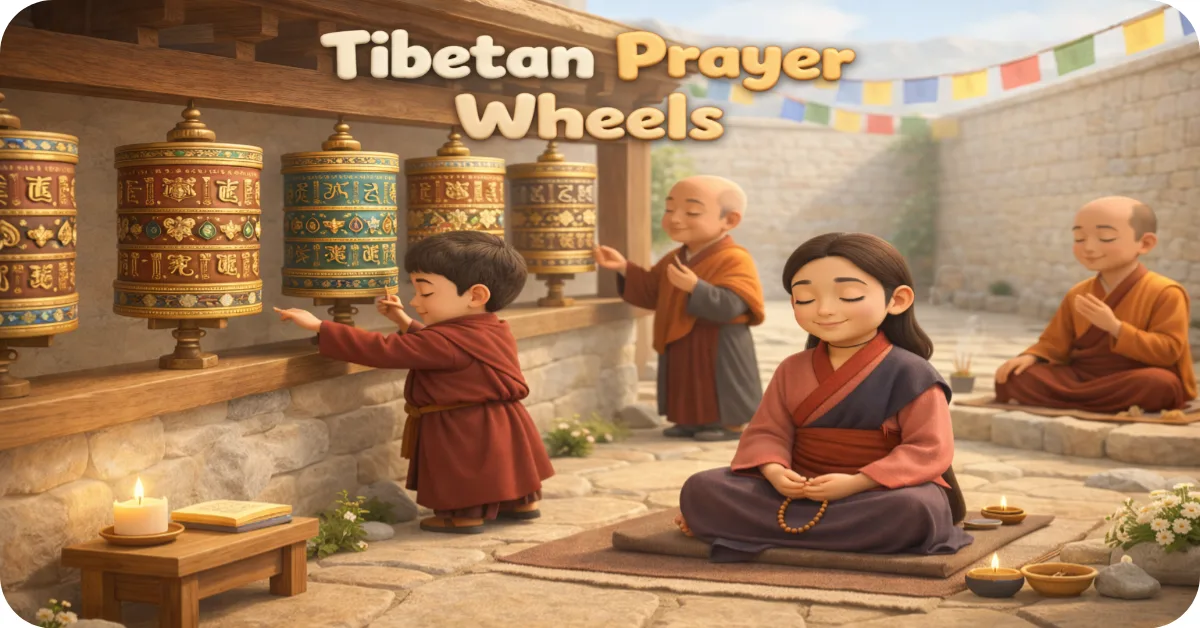
The Tibetan prayer wheel stands as one of Buddhism’s most powerful meditation tools, practiced for over 1,500 years across the Himalayan regions.
These sacred cylindrical devices contain thousands of mantras that release blessings into the universe with each rotation.
This comprehensive guide explores how prayer wheels function, their profound spiritual benefits, and the authentic traditions surrounding their use in daily practice.
What Is a Tibetan Prayer Wheel?
Prayer 1: Understanding the Sacred Wheel
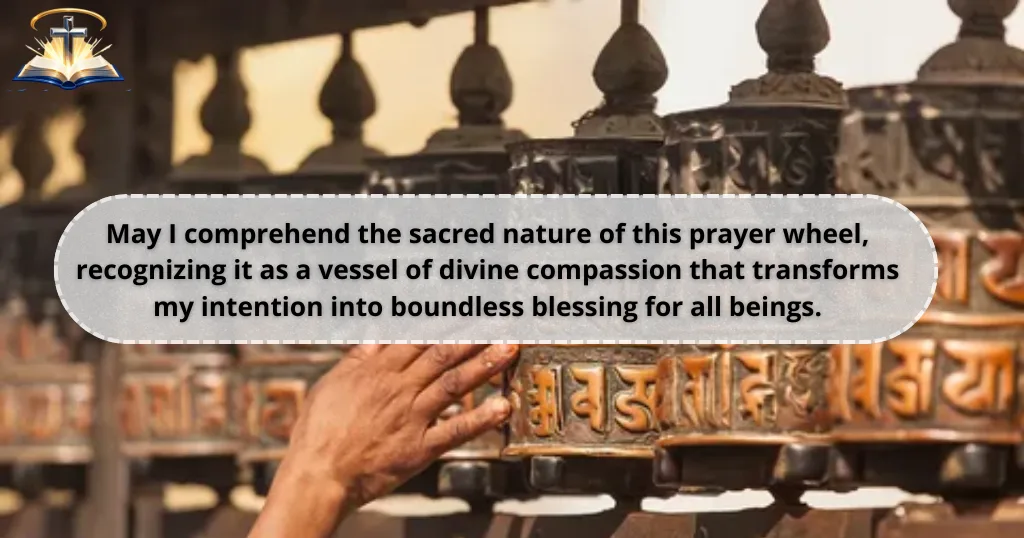
May I comprehend the sacred nature of this prayer wheel, recognizing it as a vessel of divine compassion that transforms my intention into boundless blessing for all beings.
This prayer opens your awareness to the spiritual power contained within each rotation of the wheel.
Action Item: Before touching your prayer wheel each day, pause for three breaths and set a clear intention for compassionate practice.
Dhammapada 1:1-2 – “All that we are is the result of what we have thought. The mind is everything. What we think we become.”
✩───────────────────── ⋅ ⋅ ── ✩ ── ⋅ ⋅ ─────────────────────✩
Prayer 2: History of Prayer Wheel Tradition
I honor the ancient lineage of enlightened masters who preserved this sacred practice through countless generations, connecting my spirit to the timeless wisdom of the Buddhist path.
The prayer wheel tradition originated in India during the 4th century CE and flourished throughout Tibet, Mongolia, and the broader Himalayan region by the 8th century.
Action Item: Research one historical Buddhist master like Padmasambhava or Atisha who promoted prayer wheel practice in your lineage.
Lotus Sutra 16 – “The Tathagata teaches the Dharma to living beings in accordance with what is appropriate, so difficult is it to understand.”
✩───────────────────── ⋅ ⋅ ── ✩ ── ⋅ ⋅ ─────────────────────✩
Prayer 3: Components of a Prayer Wheel
As I observe each element of this sacred instrument—the copper cylinder, the wooden spindle, the mantras within, and the weighted chain—I recognize how divine craftsmanship serves spiritual awakening.
Traditional Tibetan prayer wheels consist of a metal cylinder (often copper or brass), precisely folded mantra papers inside, a central axle for smooth rotation, and a weighted chain that maintains momentum.
Action Item: Inspect your prayer wheel’s construction monthly, ensuring the spindle rotates freely and the cylinder remains secure on its axis.
Heart Sutra – “Form is emptiness, emptiness is form; form does not differ from emptiness, emptiness does not differ from form.”
✩───────────────────── ⋅ ⋅ ── ✩ ── ⋅ ⋅ ─────────────────────✩
Prayer 4: Types of Tibetan Prayer Wheels
Whether I spin a handheld mani wheel during walking meditation, pass by temple wall wheels, or witness water-powered cylinders turning in mountain streams, each type offers a unique pathway to accumulate merit and spread compassion.
Handheld prayer wheels (mani wheels) are most common for personal practice, ranging from 4 to 12 inches tall, while wall-mounted wheels line monastery corridors for continuous spinning by visitors.
Action Item: Experience at least three different types of prayer wheels—handheld, wall-mounted, and large temple wheels—to understand how size and setting affect your practice.
Avatamsaka Sutra – “In one particle are found innumerable lands with their innumerable Buddhas.”
✩───────────────────── ⋅ ⋅ ── ✩ ── ⋅ ⋅ ─────────────────────✩
Prayer 5: Symbolism in Prayer Wheel Design
I contemplate the sacred symbols adorning this wheel—the lotus representing purity, the endless knot showing interconnection, the eight auspicious signs revealing the complete path—each detail unveiling layers of enlightened wisdom.
The eight auspicious symbols frequently decorate prayer wheels: the endless knot, lotus flower, dharma wheel, victory banner, golden fish, treasure vase, conch shell, and parasol, each carrying specific meanings about the path to enlightenment.
Action Item: Choose one symbol on your prayer wheel and spend a week meditating on its deeper meaning, journaling insights that arise.
Prajnaparamita Sutra – “All phenomena are marked with emptiness; they do not appear or disappear, are not tainted or pure, do not increase or decrease.”
✩───────────────────── ⋅ ⋅ ── ✩ ── ⋅ ⋅ ─────────────────────✩
How Does a Tibetan Prayer Wheel Work?
Prayer 6: The Sacred Mantras Inside
I honor the thousands upon thousands of mantras contained within this cylinder, each syllable a seed of compassion that blossoms with every rotation, spreading blessings to all sentient beings throughout the ten directions.
A typical prayer wheel contains the Om Mani Padme Hum mantra repeated between 100,000 to several million times, depending on the wheel’s size and the paper’s density.
Action Item: Ask the maker or seller how many mantras your specific prayer wheel contains to appreciate the magnitude of blessings released with each spin.
Karaniya Metta Sutta – “May all beings be at ease. Whatever living beings there may be, whether they are weak or strong, omitting none.”
✩───────────────────── ⋅ ⋅ ── ✩ ── ⋅ ⋅ ─────────────────────✩
Prayer 7: Clockwise Spinning Direction
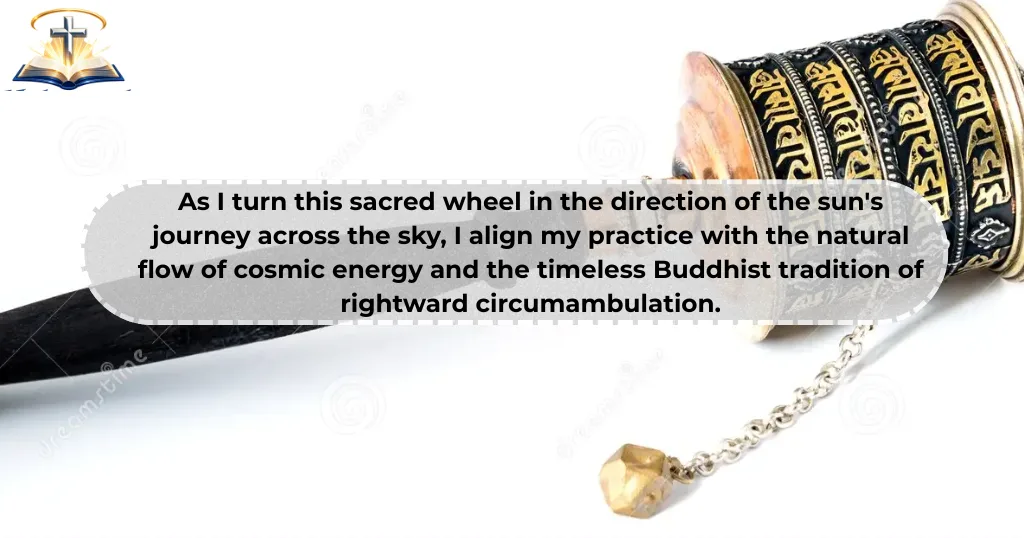
As I turn this sacred wheel in the direction of the sun’s journey across the sky, I align my practice with the natural flow of cosmic energy and the timeless Buddhist tradition of rightward circumambulation.
Spinning clockwise follows the same direction as kora (circumambulation around sacred sites), symbolizing progression on the spiritual path toward enlightenment rather than regression into ignorance.
Action Item: Before each session, consciously note which direction is clockwise to ensure your practice aligns with proper tradition.
Dhammacakkappavattana Sutta – “The Noble Eightfold Path, that is to say: right view, right intention, right speech, right action, right livelihood, right effort, right mindfulness, right concentration.”
✩───────────────────── ⋅ ⋅ ── ✩ ── ⋅ ⋅ ─────────────────────✩
Prayer 8: Prayer Wheel Activation Process
With mindful breath and focused intention, I activate this sacred instrument, understanding that the physical motion combined with pure motivation creates a powerful vehicle for spiritual transformation and merit accumulation.
The activation process requires three elements: physical spinning, mental focus on compassion, and verbal recitation or silent repetition of the mantra contained within the wheel.
Action Item: Synchronize your breathing with wheel rotations—one complete rotation per breath cycle—to enhance mindfulness and meditation depth.
Anapanasati Sutta – “Breathing in long, one knows ‘I am breathing in long’; breathing out long, one knows ‘I am breathing out long.'”
✩───────────────────── ⋅ ⋅ ── ✩ ── ⋅ ⋅ ─────────────────────✩
Prayer 9: Energy and Intention in Spinning
I recognize that the true power of this prayer wheel emerges not merely from mechanical motion but from the purity of my heart’s intention, the clarity of my compassionate wish, and my sincere dedication to the benefit of all beings.
According to Tibetan Buddhist teachings, a prayer wheel spun with genuine bodhicitta (enlightened mind of compassion) generates exponentially more merit than mindless spinning.
Action Item: Before each practice session, spend one minute cultivating loving-kindness toward all beings, then maintain this feeling while spinning.
Bodhisattvacharyavatara 1:16 – “Just as the blind might find a jewel in a heap of rubbish, so by some chance the spirit of enlightenment has been born in me.”
✩───────────────────── ⋅ ⋅ ── ✩ ── ⋅ ⋅ ─────────────────────✩
Prayer 10: Multiplying Prayers Through Rotation
With each revolution of this sacred cylinder, I release countless mantras into the universe, understanding that one physical action multiplies into thousands of blessings, creating ripples of positive energy that touch beings seen and unseen.
Traditional texts state that spinning a prayer wheel once equals reciting all the mantras contained inside, meaning a wheel with one million mantras generates merit equivalent to one million vocal recitations per rotation.
Action Item: Calculate the merit potential of your practice by multiplying the number of mantras in your wheel by your daily rotation count.
Sukhavati Sutra – “The Buddha told Ananda, ‘The adornments of that Buddha land are inconceivable.'”
✩───────────────────── ⋅ ⋅ ── ✩ ── ⋅ ⋅ ─────────────────────✩
Benefits of Spinning Tibetan Prayer Wheels
Prayer 11: Accumulating Merit and Positive Karma
Through this ancient practice of turning the sacred wheel, I accumulate vast stores of positive karma and spiritual merit, creating causes for future happiness, wisdom development, and ultimately the achievement of enlightenment for myself and all beings.
According to the Mani Kabum text, spinning a prayer wheel purifies negative karma accumulated over eons and creates merit equal to thousands of monks reciting prayers simultaneously.
Action Item: Dedicate the merit from your prayer wheel practice to a specific person or cause each day, extending the benefits beyond yourself.
Anguttara Nikaya 5:41 – “Monks, there are these five rewards in moral conduct: great wealth through heedfulness, a good reputation, confidence when approaching assemblies, an unconfused death, and rebirth in a good destination.”
✩───────────────────── ⋅ ⋅ ── ✩ ── ⋅ ⋅ ─────────────────────✩
Prayer 12: Mental Peace and Meditation Focus
As this wheel rotates beneath my touch, my restless thoughts quiet, my anxious mind settles, and I enter a state of peaceful concentration where worry dissolves and clarity naturally arises.
Studies on repetitive spiritual practices show that rhythmic activities combined with devotional focus activate the parasympathetic nervous system, reducing cortisol levels and promoting deep relaxation states similar to advanced meditation.
Action Item: Use your prayer wheel specifically during stressful moments, spinning for 3-5 minutes to restore mental equilibrium.
Satipatthana Sutta – “There is this one way, monks, for the purification of beings, for the overcoming of sorrow and lamentation, for the destruction of pain and grief, for reaching the right path, for the realization of Nibbana.”
✩───────────────────── ⋅ ⋅ ── ✩ ── ⋅ ⋅ ─────────────────────✩
Prayer 13: Purification of Negative Energy
With each clockwise turn, I visualize dark clouds of negative energy, harmful thoughts, and accumulated misdeeds dissolving into light, purified by the power of sacred mantras and transformed into the radiance of wisdom and compassion.
The Om Mani Padme Hum mantra contained in most prayer wheels specifically purifies the six realms of existence: hell beings, hungry ghosts, animals, humans, jealous gods, and gods, addressing the root afflictions of each realm.
Action Item: While spinning, visualize specific negative patterns or regrets leaving your body as dark smoke, replaced by golden light entering from above.
Vajrasattva Mantra Practice – “May all negative karma, obscurations, and habitual patterns be purified and removed.”
✩───────────────────── ⋅ ⋅ ── ✩ ── ⋅ ⋅ ─────────────────────✩
Prayer 14: Compassion Development Through Practice
As I turn this wheel with the intention to benefit all sentient beings without exception, my heart gradually expands, my empathy deepens, and my capacity to hold others’ suffering with kindness and my commitment to their liberation strengthens.
Regular prayer wheel practice trains the mind in bodhicitta, the aspiration to attain enlightenment for the benefit of all beings, which Tibetan Buddhism considers the supreme spiritual quality.
Action Item: Begin each prayer wheel session by reciting: “For the benefit of all beings throughout space, I turn this wheel,” reinforcing compassionate motivation.
Shantideva’s Prayer – “For as long as space endures and for as long as living beings remain, until then may I too abide to dispel the misery of the world.”
✩───────────────────── ⋅ ⋅ ── ✩ ── ⋅ ⋅ ─────────────────────✩
Prayer 15: Physical Movement as Spiritual Practice
I celebrate this embodied form of devotion where my hands, arms, and body participate in spiritual practice, uniting physical action with sacred intention, proving that enlightenment includes rather than excludes the material world.
Walking meditation with prayer wheels combines cardiovascular exercise with spiritual practice, making it ideal for practitioners who find seated meditation physically challenging or mentally restless.
Action Item: Take a 20-minute walk daily while spinning your handheld prayer wheel, maintaining awareness of both the physical sensations and your spiritual intention.
Buddha’s Teaching on Right Effort – “The monk generates desire for the arising of unarisen wholesome states; he makes effort, arouses energy, applies his mind, and strives.”
✩───────────────────── ⋅ ⋅ ── ✩ ── ⋅ ⋅ ─────────────────────✩
What Is Written on Tibetan Prayer Wheels?
Prayer 16: Om Mani Padme Hum Mantra
I recite this most sacred of mantras—Om Mani Padme Hum—the jewel in the lotus, Chenrezig’s compassion encoded in six syllables that purify the six realms and awaken the heart to boundless love.
The six-syllable mantra Om Mani Padme Hum appears in virtually every Tibetan prayer wheel, repeated thousands or millions of times on tightly rolled paper or cloth inside the cylinder.
Action Item: Memorize this mantra and recite it aloud or silently while spinning your wheel to amplify the practice’s power.
Mani Kabum – “The six syllables, Om Mani Padme Hum, are the essence of the 84,000 sections of the Buddha’s teachings.”
✩───────────────────── ⋅ ⋅ ── ✩ ── ⋅ ⋅ ─────────────────────✩
Prayer 17: Compassion Mantra Meaning
I contemplate the profound meaning: Om opens divine presence, Mani honors the jewel of enlightened mind, Padme celebrates the lotus of wisdom, and Hum seals the indivisible union of method and wisdom—all pointing toward the compassionate nature of reality itself.
Each syllable of Om Mani Padme Hum purifies a specific negative emotion: Om purifies pride, Ma purifies jealousy, Ni purifies desire, Pad purifies ignorance, Me purifies greed, and Hum purifies anger.
Action Item: Focus on one syllable each day for six days, contemplating which negative emotion it addresses in your personal experience.
Chenrezig Sadhana – “The bodhisattva Avalokiteshvara, looking down from on high, beheld all beings drowning in the ocean of samsara and was moved by great compassion.”
✩───────────────────── ⋅ ⋅ ── ✩ ── ⋅ ⋅ ─────────────────────✩
Prayer 18: Other Sacred Tibetan Mantras
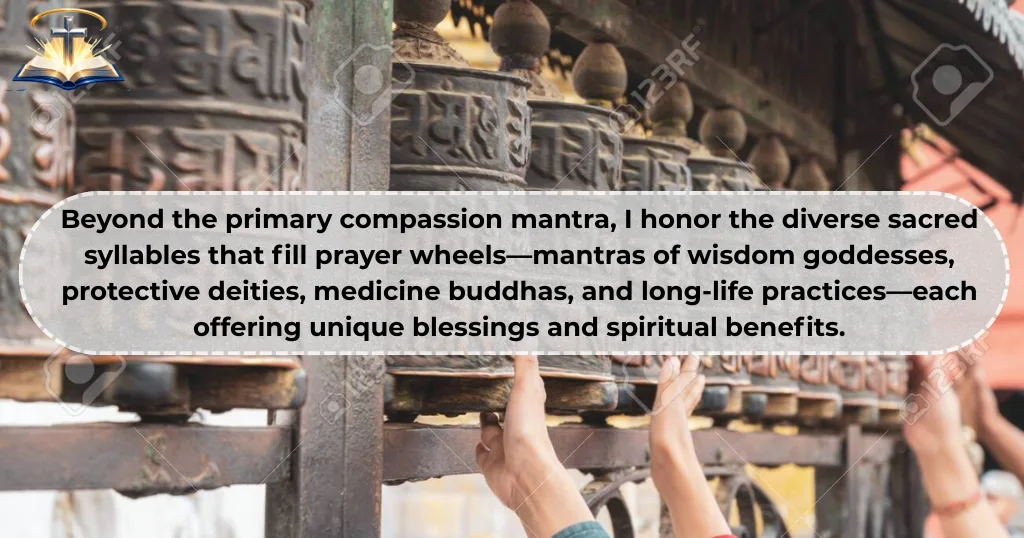
Beyond the primary compassion mantra, I honor the diverse sacred syllables that fill prayer wheels—mantras of wisdom goddesses, protective deities, medicine buddhas, and long-life practices—each offering unique blessings and spiritual benefits.
Some specialized prayer wheels contain Tara mantras (Om Tare Tuttare Ture Soha), Medicine Buddha mantras (Tayata Om Bekanze Bekanze Maha Bekanze Radza Samudgate Soha), or Manjushri wisdom mantras (Om Ah Ra Pa Tsa Na Dhih).
Action Item: If you have specific spiritual needs like healing or wisdom development, seek a prayer wheel containing the appropriate deity mantra.
Tara Tantra – “She who saves, she who protects, the mother of all the Victorious Ones.”
✩───────────────────── ⋅ ⋅ ── ✩ ── ⋅ ⋅ ─────────────────────✩
Prayer 19: Visual Symbols on Prayer Wheels
I observe the sacred scripts adorning the cylinder’s exterior—the flowing Tibetan letters spelling Om Mani Padme Hum, the jewel designs representing enlightened mind, and the lotus petals symbolizing purity emerging from the mud of cyclic existence.
The exterior surface typically displays the mantra in Lantsa script (an ancient Indian script considered especially sacred) or Tibetan Uchen script, along with the eight auspicious symbols and images of Chenrezig (Avalokiteshvara).
Action Item: Learn to recognize the Tibetan letters of Om Mani Padme Hum so you can identify authentic prayer wheels and appreciate their artistic beauty.
Mahayana Teaching – “The Dharma is expressed through symbols, sounds, and sacred forms that serve as bridges to the ineffable truth.”
✩───────────────────── ⋅ ⋅ ── ✩ ── ⋅ ⋅ ─────────────────────✩
Prayer 20: Number of Mantras Inside Wheels
I stand in awe contemplating that within this small cylinder rest hundreds of thousands or even millions of mantra repetitions, each one a complete prayer, and with one effortless rotation I release this vast accumulation of blessings into the world.
Small handheld wheels typically contain 100,000 to 500,000 mantra repetitions, while large temple prayer wheels may contain 10 million to over 100 million mantras, with some giant wheels holding over one billion repetitions.
Action Item: Request or research the exact mantra count in your specific prayer wheel to fully appreciate the magnitude of each rotation.
Sutra of Golden Light – “Even if one were to place as many Buddha images as there are grains of sand in the Ganges River in a stupa, it would not equal the merit of copying this sutra once.”
✩───────────────────── ⋅ ⋅ ── ✩ ── ⋅ ⋅ ─────────────────────✩
Rules and Etiquette for Using Prayer Wheels
Prayer 21: Correct Spinning Direction
I commit to always spinning this sacred wheel clockwise, in the direction of the sun’s path and dharma’s natural flow, respecting the ancient tradition that ensures my practice aligns with cosmic principles and generates positive rather than negative energy.
Counterclockwise spinning is considered inauspicious in Tibetan Buddhism as it reverses the mantras and contradicts the symbolic journey toward enlightenment.
Action Item: Mark your prayer wheel with a small dot or symbol indicating the clockwise direction to prevent accidental reverse spinning.
Kalachakra Tantra – “The movements of the sun, moon, and planets follow the rightward path; so too does the practitioner move clockwise around sacred objects.”
✩───────────────────── ⋅ ⋅ ── ✩ ── ⋅ ⋅ ─────────────────────✩
Prayer 22: Intention Setting Before Spinning
Before my hand touches this sacred object, I pause to set clear motivation, cultivating bodhicitta and dedicating all merit from this practice to the enlightenment of every being throughout infinite space—this pure intention transforms mechanical action into profound spiritual practice.
Traditional Tibetan practitioners recite the Four Immeasurables before prayer wheel practice: “May all beings have happiness and its causes, be free from suffering and its causes, never be separated from true happiness, and rest in equanimity.”
Action Item: Create a brief personal intention statement and recite it mentally before every prayer wheel session.
Bodhicharyavatara – “Whatever joy there is in this world, all comes from desiring others to be happy. Whatever suffering there is in this world, all comes from desiring myself to be happy.”
✩───────────────────── ⋅ ⋅ ── ✩ ── ⋅ ⋅ ─────────────────────✩
Prayer 23: Respectful Handling of Sacred Objects
I treat this prayer wheel as I would treat a precious Buddha statue or sacred text, never placing it on the ground, keeping it clean and protected, storing it mindfully, and approaching it always with reverence and gratitude for this powerful dharma tool.
Sacred objects should be placed on clean, elevated surfaces wrapped in clean cloth when not in use, never in bathrooms or other impure spaces, and handled with washed hands.
Action Item: Designate a specific clean shelf or altar space for your prayer wheel and create a simple cloth bag or box for protection during travel.
Vinaya Teachings – “Show respect to sacred objects as you would to the Buddha himself, for they embody the teachings and serve as supports for practice.”
✩───────────────────── ⋅ ⋅ ── ✩ ── ⋅ ⋅ ─────────────────────✩
Prayer 24: Prayer Wheel Placement Guidelines
Whether I install a wall-mounted wheel in my home, position a standing wheel in my meditation space, or carry a handheld wheel during walks, I choose locations that honor the sacred nature of this object—clean, elevated, and treated with dignity.
Home prayer wheels should be placed above waist height, preferably on an altar or shelf with other sacred objects, facing outward where they can be easily accessed but protected from accidental damage.
Action Item: Create a dedicated prayer wheel station in your home with good lighting, comfortable standing space, and perhaps a small cushion for kneeling practice.
Tibetan Buddhist Tradition – “Sacred objects should be positioned where they receive natural light, face auspicious directions, and remain accessible for daily practice.”
✩───────────────────── ⋅ ⋅ ── ✩ ── ⋅ ⋅ ─────────────────────✩
Prayer 25: Daily Practice Recommendations
I commit to making prayer wheel practice a consistent part of my spiritual routine, understanding that regular engagement—whether 108 rotations daily or continuous spinning during walking meditation—accumulates merit steadily like drops filling an ocean.
Traditional practitioners aim for at least 108 rotations daily (matching mala bead counts), while dedicated practitioners may spin continuously for 30-60 minutes or more, especially during losar (Tibetan New Year) and other auspicious occasions.
Action Item: Start with a manageable goal like 108 daily spins (about 3-5 minutes) and gradually increase as the practice becomes habitual.
Milarepa’s Teaching – “At first nothing comes, in the middle nothing stays, at the end nothing goes. Yet from continuous practice, accomplishment naturally arises.”
✩───────────────────── ⋅ ⋅ ── ✩ ── ⋅ ⋅ ─────────────────────✩
Incorporating Tibetan Prayer Wheels in Your Spiritual Practice
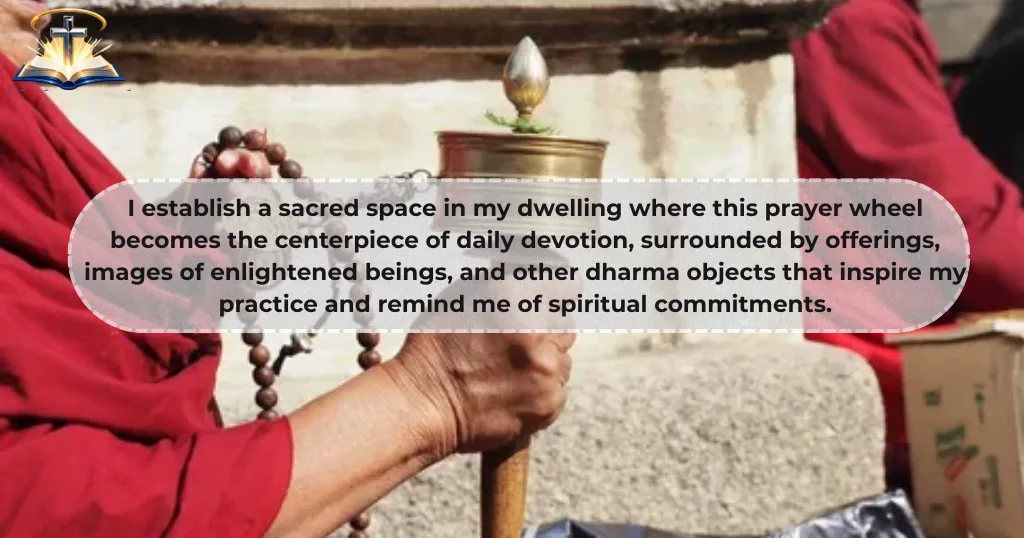
Prayer 26: Creating a Home Prayer Wheel Altar
I establish a sacred space in my dwelling where this prayer wheel becomes the centerpiece of daily devotion, surrounded by offerings, images of enlightened beings, and other dharma objects that inspire my practice and remind me of spiritual commitments.
A traditional prayer wheel altar includes the wheel itself, a Buddha or Chenrezig image, fresh water offerings, incense, flowers (when available), and perhaps a butter lamp or candle.
Action Item: Dedicate a specific corner or shelf exclusively to your prayer wheel practice, arranging it beautifully to inspire daily engagement.
Altar Practice Teachings – “Creating sacred space trains the mind in devotion, beauty reminds us of purity, and ritual establishes consistency in practice.”
✩───────────────────── ⋅ ⋅ ── ✩ ── ⋅ ⋅ ─────────────────────✩
Prayer 27: Prayer Wheel Meditation Practice
I develop a formal meditation practice centered on this sacred wheel, beginning with refuge and bodhicitta, maintaining mindful awareness during rotation, and concluding with merit dedication—transforming simple spinning into complete spiritual training.
A complete prayer wheel session includes: refuge prayer (3x), bodhicitta generation, main practice (spinning with mantra), dedication of merit, and optionally, prostrations or additional prayers before and after.
Action Item: Set a timer for 15 minutes of focused prayer wheel meditation, minimizing distractions and maintaining present-moment awareness throughout.
Meditation Instructions – “Single-pointed concentration on one practice leads to stability; stability leads to insight; insight leads to liberation.”
✩───────────────────── ⋅ ⋅ ── ✩ ── ⋅ ⋅ ─────────────────────✩
Prayer 28: Walking Meditation with Prayer Wheels
I unite body and spirit through walking meditation, holding this sacred wheel gently, spinning it continuously with a natural rhythm that matches my footsteps, bringing mindful awareness to each movement while mantras flow endlessly into space.
Circumambulation practice (kora) with prayer wheels is especially popular around temples, stupas, or sacred mountains, combining pilgrimage, exercise, meditation, and merit accumulation in one integrated practice.
Action Item: Find a peaceful outdoor path or park where you can walk for 20-30 minutes daily while spinning your prayer wheel and maintaining awareness.
Walking Meditation Sutra – “Whether walking, standing, sitting, or lying down, bring awareness to the activity itself; this is the path to mindfulness.”
✩───────────────────── ⋅ ⋅ ── ✩ ── ⋅ ⋅ ─────────────────────✩
Prayer 29: Combining Prayer Wheels with Other Practices
I recognize that prayer wheel practice harmonizes beautifully with prostrations, mantra recitation, visualization, tonglen breathing practice, and analytical meditation, each method supporting and enhancing the others in my comprehensive spiritual development.
Many practitioners combine prayer wheel spinning with mala counting (using prayer beads), silently reciting Om Mani Padme Hum with each bead while simultaneously spinning the wheel.
Action Item: Experiment with combining your prayer wheel practice with another technique you’re already learning, noticing how they synergize.
Integrated Practice Teaching – “Like legs working together to walk, multiple practices support each other, accelerating progress when properly combined with understanding.”
✩───────────────────── ⋅ ⋅ ── ✩ ── ⋅ ⋅ ─────────────────────✩
Prayer 30: Choosing Your First Tibetan Prayer Wheel
As I prepare to select my first prayer wheel, I consider size, material quality, mantra authenticity, aesthetic beauty, and most importantly, which wheel naturally resonates with my heart—trusting that the right dharma tool will find me when I’m truly ready to commit to practice.
Authentic Tibetan prayer wheels are typically made in Nepal, Tibet, or India using traditional methods, with genuine mantras hand-printed or woodblock-printed, copper or brass construction, and smooth-spinning mechanisms.
Action Item: Purchase your first prayer wheel from a reputable Tibetan Buddhist supplier, monastery shop, or fair-trade Himalayan crafts organization to ensure authenticity and support traditional artisans.
Teaching on Right Livelihood – “Support those whose work spreads the dharma and preserves sacred traditions; in doing so, you participate in sustaining the teachings for future generations.”
✩───────────────────── ⋅ ⋅ ── ✩ ── ⋅ ⋅ ─────────────────────✩
Related Buddhist Teachings About Prayer Wheels
“Whoever spins a prayer wheel with devotion purifies negative karma accumulated through body, speech, and mind.”
➣ Mani Kabum
“The benefits of turning the wheel of dharma are inconceivable. One rotation equals the merit of reciting all the mantras inside.”
➣ Padmasambhava’s Teaching
“When you spin a prayer wheel filled with mantras, all the Buddhas and Bodhisattvas pay attention to you with great joy.”
➣ Karma Chakme Rinpoche
“Even insects that are touched by the shadow of a prayer wheel are freed from rebirth in lower realms.”
➣ Traditional Tibetan Teaching
“In this degenerate age, the prayer wheel is especially powerful because it requires little effort yet produces vast merit, making it accessible to all beings regardless of their capacity.”
➣ Dilgo Khyentse Rinpoche
FAQ
How does a Tibetan prayer wheel work?
A Tibetan prayer wheel contains thousands of mantras written on paper inside a cylinder that spins clockwise on an axle, releasing all the mantras’ blessings with each rotation, equivalent to reciting each mantra individually.
Which way do you spin a Tibetan prayer wheel?
Always spin a prayer wheel clockwise (to your right) when facing it, following the same direction as Buddhist circumambulation around sacred sites and temples, which represents moving forward on the spiritual path.
What are the benefits of spinning prayer wheels?
Spinning prayer wheels purifies negative karma, accumulates positive merit, develops compassion, brings mental peace, enhances meditation focus, and spreads blessings to all beings throughout space with minimal physical effort.
What is written on a prayer wheel?
Most prayer wheels contain the mantra Om Mani Padme Hum repeated thousands or millions of times, along with other mantras like Tara prayers or Medicine Buddha mantras, plus sacred symbols on the exterior.
Are there any rules for using a prayer wheel?
Yes, always spin clockwise, set compassionate intention before practice, handle respectfully, keep clean and elevated, never place on the ground, and approach with reverence as you would sacred texts or Buddha images.
Is Buddhism supporting LGBT?
Buddhist teachings focus on reducing suffering and cultivating compassion for all beings without distinction, with many contemporary Buddhist teachers and communities affirming LGBTQ+ inclusion, though views vary across different traditions and cultures.
Conclusion
The Tibetan prayer wheel offers a profound yet accessible spiritual practice that transforms simple physical motion into powerful merit accumulation and compassion development.
By incorporating this ancient tradition into your daily routine with proper understanding, respectful handling, and sincere intention, you join millions of practitioners across centuries
who have discovered how these sacred cylinders serve as vehicles for spreading blessings throughout the world.
At HolyLordPrayer.com, Olivia Jain shares heartfelt prayers, reflections, and spiritual guidance designed to bring peace, faith, and divine connection into everyday life. Her work is devoted to creating a sacred space where readers can find comfort, strengthen their belief, and reconnect with hope through prayer. Each message is crafted to inspire calm, healing, and a deeper relationship with the Lord.